October 8, 2026
What is Negative Keyword Strategy?
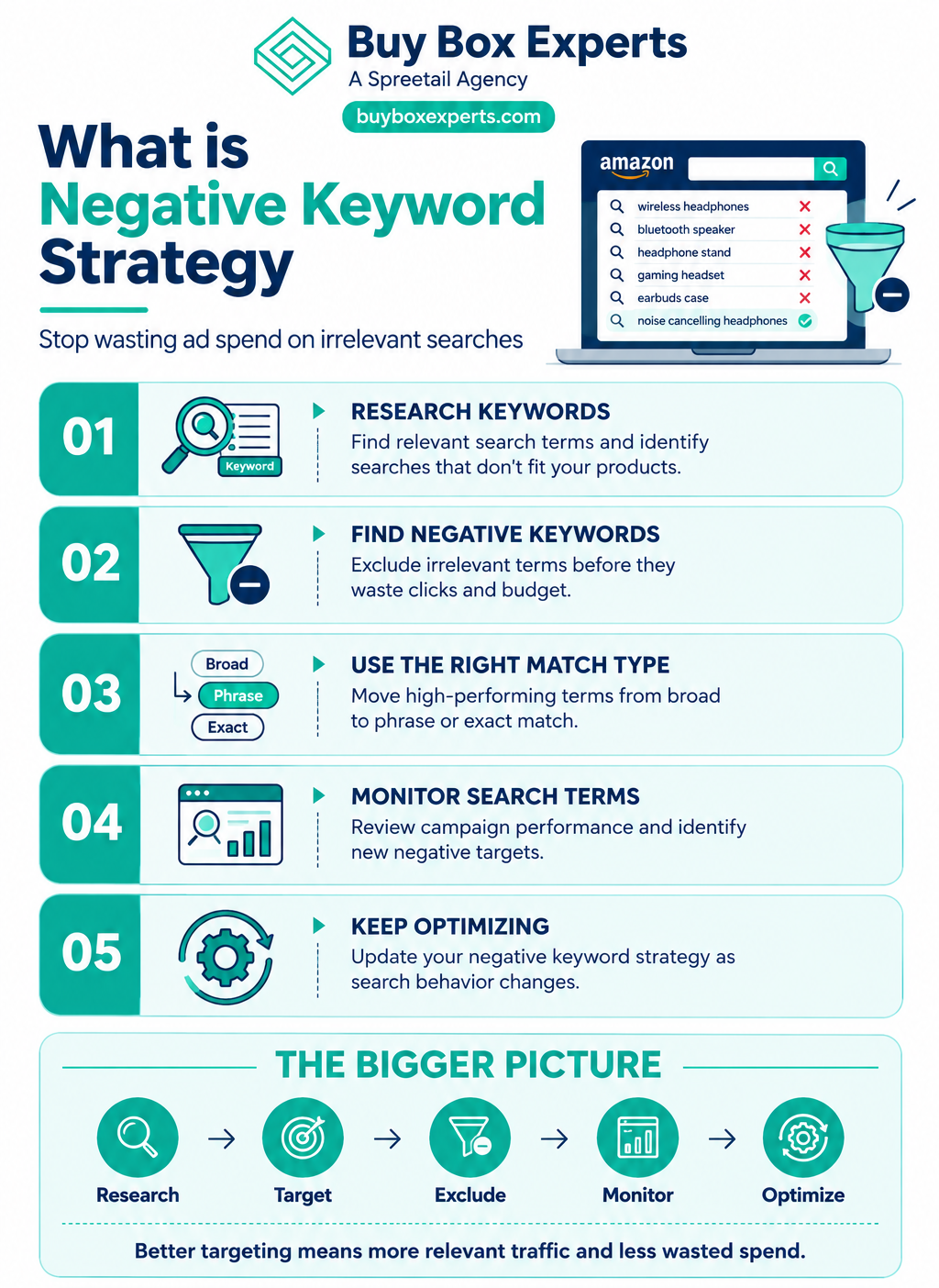
When establishing a PPC strategy, establishing a keyword strategy is a must. However, many companies neglect or even forget to incorporate a negative keyword strategy. Establishing an effective negative keyword strategy in conjunction with regular keyword research helps determine which keywords are useful to include in ad campaigns and A+ Content.
Negative keywords are words or phrases that would not be helpful to product sales. For instance, if a company sells children’s rain boots, searches for men’s or women’s rain boots would not be useful or result in relevant customer traffic. This phrase would be included in the negative keyword list.
While negative keyword strategy can sometimes be swept under the rug, having a good understanding of negative keywords strategy can be a great asset to companies looking to grow the online presence of their business and increase their sales by attracting more relevant consumer traffic.
Keyword Research
Amazon Sponsored Products keyword targeting uses three match types: broad match, phrase match, and exact match; negative targeting is used separately to exclude unwanted shopping queries. Sellers should be aware of these distinctions to properly understand research findings, to integrate high-value keywords into their A+ Content, and to discover negative keywords.
Broad Match Keywords
Broad match gives ads the widest reach. Shopping queries can contain keyword terms in any order and may include variations, synonyms, and related terms. For example, if you were bidding on the keyword Harry Potter, your ad might show up for Hary Potter (misspelling) or Harry Potter books. For negative keyword strategy, broad match is useful for discovering search terms that attract irrelevant traffic and may need to be excluded.
Phrase Match Keywords
Phrase match is more restrictive than broad match. The shopping query contains the keyword phrase in the same order, while additional words or close variations may appear. For example, the phrase match keyword Harry Potter socks could match fuzzy Harry Potter socks. Reviewing phrase match search terms can help identify irrelevant queries that should be added as negative keywords.
Exact Match Keywords
Exact match is the most restrictive match type and is designed for highly relevant shopping queries that closely match the targeted keyword. Use search-term performance across match types to identify irrelevant traffic and decide what should be excluded through negative targeting.
Negative Keywords
As mentioned, negative keywords are words or phrases that sellers don’t want to bid on. When conducting keyword research, be proactive and identify negative keywords to add to campaigns before they go live. Selecting negative keywords beforehand can save money that could otherwise be wasted on irrelevant clicks. Amazon notes that negative targeting can help improve campaign performance and spend by excluding keywords, products, or brands you don’t want associated with your ads.
Adjusting Live Campaigns
Once the keyword research process is finished and your campaigns are running, you need to keep an eye on keyword performance. Broad match keywords that perform well and yield a high search volume should be moved to either “phrase match” or “exact match” keywords. Before adding a keyword as a negative target, Amazon recommends evaluating its performance after it has received at least 20 clicks. Once negative keywords are in place, Amazon recommends letting them run for two weeks or more before changing your strategy.
Any keywords that result in searches that you don’t actually want to bid on should be set to negative keywords. If your company sold socks but not shoes, you may want to add shoes as a negative keyword. Amazon’s Search Term Report can also be used to identify search terms that don’t meet your campaign goals and turn them into negative keyword or product targets.
Having clearly defined keyword categories helps sellers be more organized as they develop their brands; however, it can be a challenging process when undertaken in conjunction with the regular time demands of running a business. Many online sellers neglect this process, relying on guesswork or incomplete keyword research for their advertising. But guesswork doesn’t always yield effective results.
Simplifying the Process
Because there’s no exact science to crafting a negative keyword strategy, it does take a considerable amount of industry knowledge and experience to negotiate keyword research processes, coordinating them with Amazon bidding auctions and then integrating the appropriate keywords into the proper categories and the brand’s A+ Content.