September 29, 2026
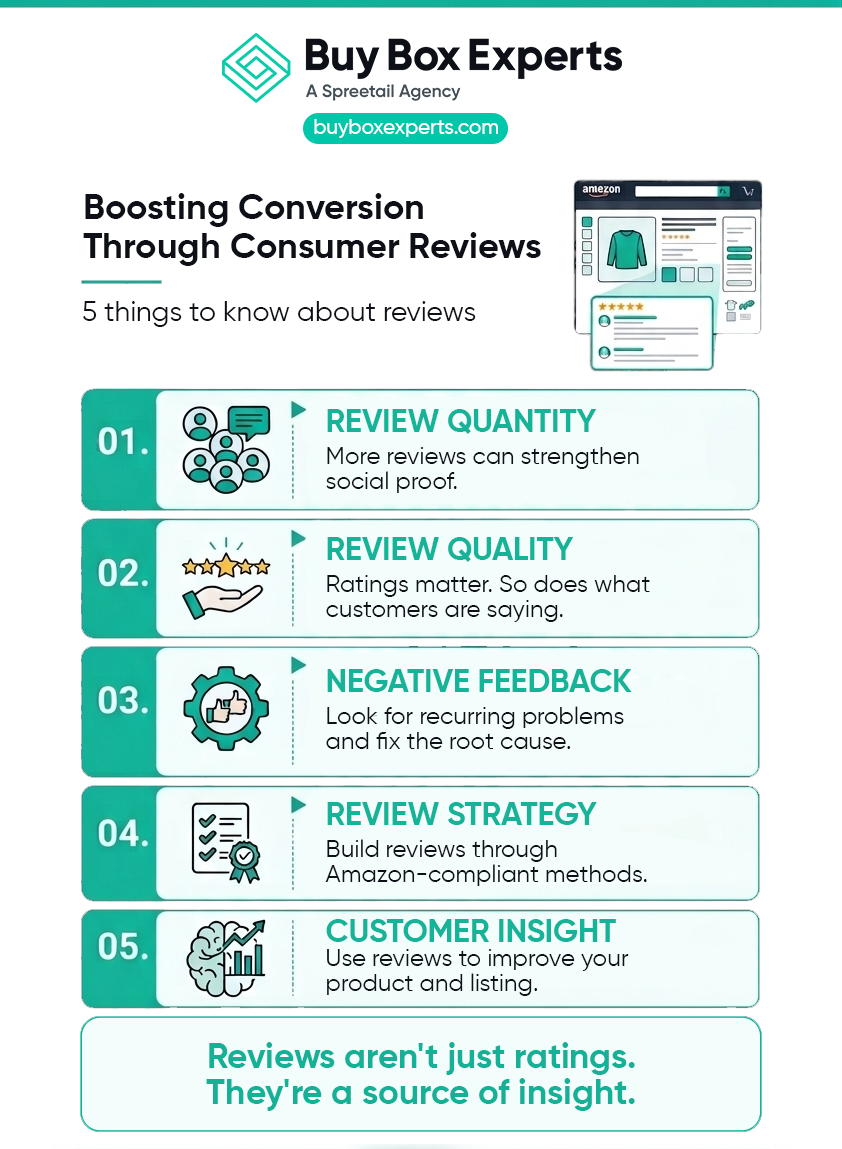
Boosting Conversion Through Consumer Reviews
For online sellers looking to strengthen their presence, customer reviews can either make or break their Amazon ranking. Keeping track of customer reviews and feedback can help companies understand what is driving conversion and sales rank.
In today’s market, online reviews carry as much weight (if not more) than in-person reviews. When searching on Amazon, consumers first notice the quantity and quality of reviews. With online purchase decisions moving quickly, most potential buyers are immediately drawn to products with more reviews as an easy indication of good product performance.
Quantity of Reviews
Although having thousands of reviews doesn’t necessarily mean a listing will perform well, it’s a simple fact that a product with 1,000 reviews does better than a product with 10. This is because shoppers value transparency. They want to know the good and the bad so they know what to expect. There’s no magic number of reviews to shoot for. Instead, online sellers should keep a close eye on the review volume of their competitors.
Products with larger numbers of reviews than their competitors are also more likely to capture sales even when the qualities are comparable. If two similar products both have an average rating of 4.5, the product with the higher quantity is seen as having a stronger, more validated rating. To stay competitive on Amazon, sellers should keep tabs on their competitors’ reviews and actively work to match or exceed it.
Quality of Reviews
While review quantity is relative to a company’s competition, review quality, from one star to five stars, is based primarily on the consumer's experience with that particular item. That makes negative feedback important to address before it pulls down the product’s overall rating.
Generally, a product needs a general consumer rating of at least 4.5 stars to generate an impulse buy. Negative reviews can drag this overall rating down, stalling the seller’s success.
Unfortunately, when consumers are presented multiple reviews, most are drawn to negative responses. Research shows that it can take up to 12 positive reviews to counteract the effect of 1 negative review.
But how can sellers combat negative reviews?
Neutralizing Negative Reviews
Because Amazon does not allow businesses to remove negative reviews, they must learn how to mitigate the negative effects. The priority should be creating positive customer experiences and addressing the issues behind recurring negative feedback. Generating more positive reviews can ultimately balance out negative reviews.
However, it’s not enough to just get more reviews, even if they are all positive. Sellers should respond to negative feedback immediately by addressing the underlying customer-service issue through permitted Amazon channels, where appropriate, and offering a full return, another product, or refund when warranted. Sellers must not ask customers to change or remove a review, and refunds, discounts, free products, or other compensation cannot be conditioned on a review or review change. Making a concentrated effort to improve the dissatisfied customer’s experience builds trust by demonstrating a dedication to working through issues.
Companies should be aware of the dangers of offering incentives for reviews. In fact, this practice should be carefully and entirely avoided. Incentivized reviews often generate biased and inaccurate feedback. Thus, in October 2016, Amazon actually banned the practice of incentivized reviews in an effort to encourage impartiality and accuracy in product reviews.
Amazon’s current policy continues to prohibit financial rewards, discounts, free products, refunds, or other compensation in exchange for reviews, and it also prohibits asking customers to change or remove reviews. It may seem like a tall order, but a careful review strategy can positively impact sales over time.
Exposure on Review-Friendly Sites
Posting discounted product listings on third-party review clubs in exchange for Amazon reviews is no longer a compliant tactic. Amazon prohibits sellers from using third-party services, websites, or social media groups that offer financial rewards, free or discounted products, reimbursements, or other compensation tied to reviews. Sellers should use Amazon-sanctioned review mechanisms instead.
But remember the difference between verified and unverified reviews. Verified Amazon reviews come from customers who purchased the product through Amazon and received the “Verified Purchase” designation; paying full price is not the defining requirement. Amazon says purchase verification is one of the authenticity factors its star-rating models weigh more heavily.
Unverified reviews, on the other hand, are reviews left on products by customers who may not have purchased the item on Amazon. A discounted purchase is not automatically unverified, and Amazon does not simply exclude every unverified review from the star-rating calculation. Its current rating system uses advanced models that consider factors including review recency and whether the review came from a verified purchase.
Simplifying the Process
Because cultivating reviews can be time-consuming and often requires extensive industry knowledge to be effective, building enough reviews to support conversion can feel daunting for many online sellers.
With Buy Box Experts’s time-tested experience, we offer a range of services that support compliant review generation and customer engagement while helping clients strengthen overall Amazon performance. These services include:
- Specialized Email Automation: Review-request automation must comply with Amazon’s communication policies. Amazon recommends using the “Request a Review” feature on the Order Details page instead of sending separate review requests through email or Buyer-Seller Messaging. The feature can be used once per order between 5 and 30 days after delivery.
- Posting on Review-Friendly Sites: Third-party review clubs that tie free or discounted products, refunds, or other compensation to Amazon reviews should not be used. Amazon’s current policy explicitly prohibits these arrangements, including through third-party services, websites, and social media groups.
- Driving Social Media Traffic: Calculated social media campaigns drive consumer traffic and encourage feedback. Social media also helps brands stay visible and maintain customer relationships beyond the product page.
- Product Inserts & QR Codes: Product inserts and QR codes can provide product instructions or legitimate customer-support information, but they must not request a positive Amazon review, offer an incentive in exchange for a review, or ask customers to change or remove a review.
At Buy Box Experts, we guide our clients through these complicated processes and provide them with the tools and resources necessary to succeed in the fast-paced e-commerce market. Because we stay with clients from start to finish, we tailor each Amazon strategy to the brand and adjust it as the marketplace changes.