October 10, 2026
Ecommerce Guide: Amazon Product Detail Page Optimization
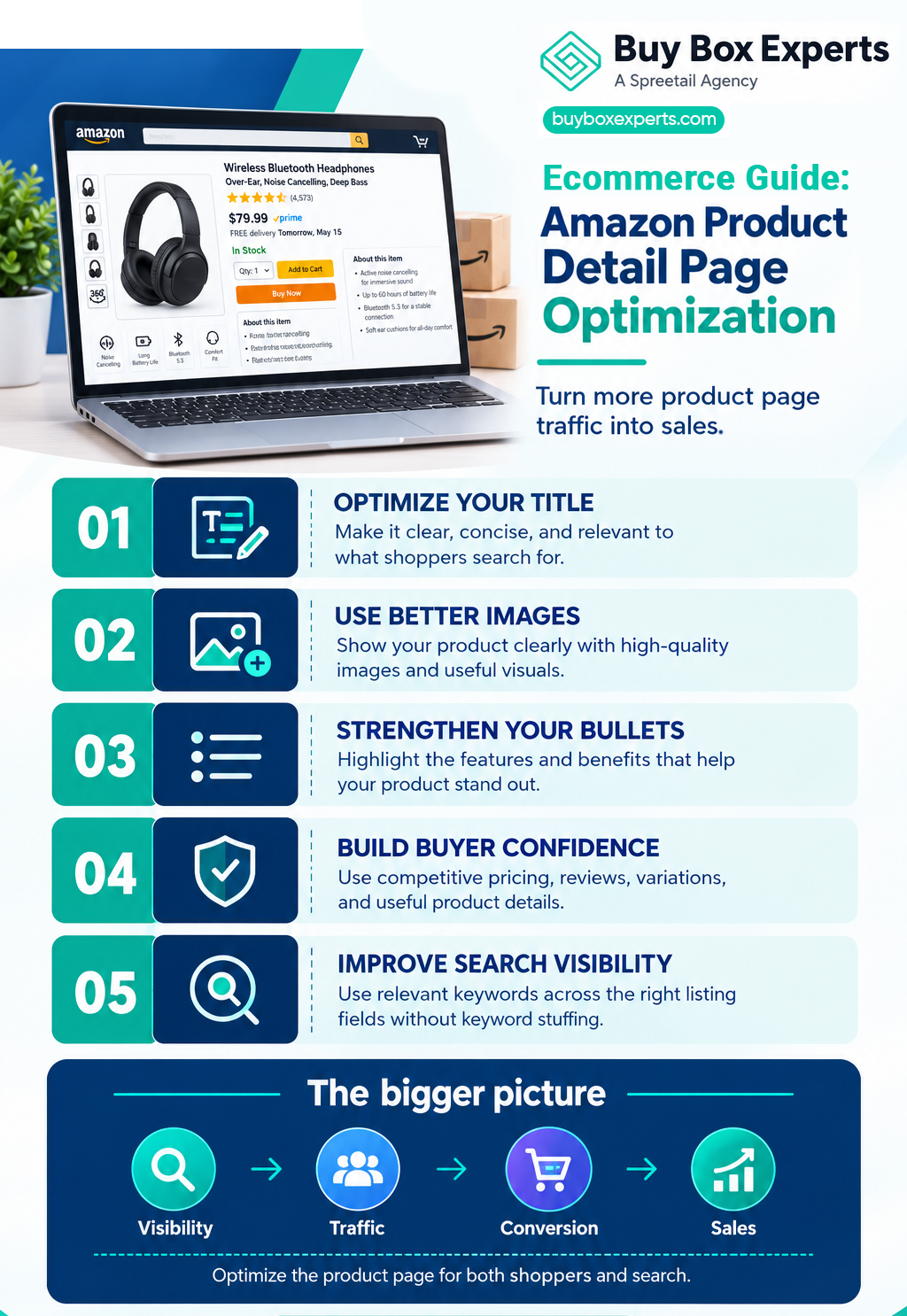
Most brands approach product detail page (PDP) optimization as a simple creative task: improve the images, polish the copy, and add keywords. But that thinking misses the real lever. PDP optimization is actually a decision-making framework about what drives your conversion and how that conversion shapes your search visibility.
Here's the dynamic: Amazon’s algorithm scores products based on traffic (sessions), purchases, and conversion rate. Products that convert visitors at higher rates rank higher for relevant search terms. Conversely, products with high traffic but low conversion signal weakness to Amazon’s algorithm; they may not rank well despite receiving clicks. This means your PDP isn’t just a sales tool. It’s the engine that determines your search performance.
The question isn’t “should we optimize?” It’s “what’s preventing our conversion, and what decision does that insight require?”
The Conversion Diagnosis: What’s Actually Limiting Sales
Amazon’s baseline requirements (title, description, bullet points, images, brand) establish a baseline for optimization. Listings with these minimum elements rank higher than incomplete ones for new or private-label products, but even established brands can benefit in performance when PDP content is optimized to clearly communicate benefits and features.
Before you complete the work, it’s important to ask these questions to diagnose the exact problem:
- Unclear or incomplete product positioning? Within the allowed character limits, the title, item highlights, and bullets should immediately answer the following: What is this product, what makes it different, and why should I buy it instead of alternatives? If a customer lands on your page and can’t quickly answer these questions, they will leave.
- Weak visual evidence? Low-resolution images, unclear main shots, or a lack of lifestyle context (scale, application, environment) undermine buyer confidence. Customers need to see your product clearly and understand how it fits their life. Secondary marketing images showing product use, scale, and detail close the gap between interest and conviction.
- Missing or weak social proof? Reviews and ratings are peer credibility signals. More reviews (especially verified purchases and recent ones) with higher star ratings generate buyer confidence, a trust factor that significantly influences conversion. If you have little or no review history, you’re starting from a deficit. If you have reviews but they’re negative, no amount of PDP optimization will compensate.
- Product variations scattered across multiple pages? If customers must leave your detail page to find an alternate color or size, many will abandon the purchase. Keeping related options (color, size, pack quantity) on a single page through valid parent-child variations keeps customers in your funnel.
What You Control: The Levers That Drive Conversion
Maximizing the control you have over your own product listing presentation is an easy way to eliminate variables when creating your conversion strategies. SEO application, visual quality, feature presentation, variation organization, and other factors can be reviewed and adjusted before you even start discussing an ads budget.
Titles
Your title has 75 characters (non-Media categories, as of July 2026) to communicate what the product is. Include brand, product type, key attributes (material, color, size, quantity), and your unique positioning. The goal is clarity first, search optimization second.
Avoid keyword stuffing; it signals weakness, not strength. Customers have short attention spans. You have seconds to capture interest before they scroll or leave. A clean, detailed title that communicates value outperforms a keyword-dense title that confuses.
For private-label products, add adjectives that differentiate: “luxury,” “premium,” “handcrafted,” “made in the USA” signal positioning. These work because they communicate not just the product, but also the buyer’s identity choice.
Images
High-resolution main images with white backgrounds and products filling 85% of frame establish visual clarity, but conversion lives in secondary images. Lifestyle shots showing scale and use, multiple angles, close-ups of quality details, and graphical overlays communicating features turn image galleries into conversion tools. Keep all images at 1,000 pixels minimum and aim for 2,000-pixel sizes to ensure clear viewing.
Think diagnostically: if your main image is weak, buyers never scroll to secondary images. If secondary images are missing texture, context, or scale, buyers will remain uncertain about fit.
Bullet Points
These are where you differentiate in crowded categories. Four to five bullets should communicate key features and benefits—not exhaustively, but strategically. If all competitors mention battery life and speed, mention yours too, but don’t stop there. What’s unique? What solves a problem competitors don’t address?
For private label, bullets are often the deciding factor when product specs are similar. Use them to communicate your unique value proposition, not to list specifications.
Social Proof
Reviews are credibility. Without them, you’re asking customers to trust you blindly. With them, you benefit from peer validation. The diagnostic question is: are you accumulating reviews fast enough? If not, are you soliciting them effectively through Amazon’s approved Request a Review workflow?
It’s also important to use reviews as a diagnostic tool for further PDP optimization. If the reviews repeatedly mention a particular benefit in a positive light, consider highlighting it more in the bullets. If feedback reveals complaints about a product that could be interpreted as misinformation, clarify language and features so that questions are answered before they appear in a review.
Product Variations
Valid variations (minor differences in color, size, and pack size that don’t affect functionality) consolidate reviews and keep customers on your page. Understand which variations apply to your catalog and structure accordingly.
Strategic Content Architecture: Beyond Minimum Requirements
Amazon’s minimum requirements establish a floor. Differentiation requires strategy.
- A+ Content (for eligible Professional sellers and Brand Registry members) enables richer storytelling: enhanced images, videos, comparison charts, and structured text. If eligible, this is where you build narrative around benefits and differentiation beyond bullet points.
- Standard Descriptions: These appear below the fold and rarely drive initial purchase decisions. Use them for detailed product information, specifications, care instructions, and any content that belongs in prose form rather than bullets. If your product is ineligible for A+, descriptions provide necessary context.
- Answered Questions: Visible Q&A on Brand Story product page features can help address customer objections directly. If you're seeing repeated questions, that signals a content gap in your bullets or description that a Q&A can help to directly fill.
Keyword Optimization: The Secondary Lever
Once conversion is optimized, consider keyword visibility. Here’s the distinction: conversion optimization increases your conversion rate (same traffic, more sales). Keyword optimization increases traffic (which keywords you appear for).
Amazon’s algorithm ranks products using sales history and conversion signals. A product optimized for conversion but invisible in search generates limited sales. A product visible in search but poor at converting wastes traffic.
Priority: Optimize conversion first. Then optimize for keyword visibility.
How Keywords Influence Ranking
Your title, item highlights, brand, search terms, and product attributes all contribute to relevance scoring. Amazon analyzes these fields to determine which search queries your product matches.
- Title keyword placement: Keywords matter, but clarity matters more. Each word in your title is individually searchable. Include brand, product type, and attributes customers search for. Given character limits, prioritize essential product identification over keyword density.
- Item Highlights: This 125-character field allows additional searchable information (materials, use cases, recommended applications) without forcing everything into your title. Use it strategically.
- Search Terms Field: Amazon provides a generic search-terms field with a 250-byte limit. Use it for relevant synonyms, alternate names, abbreviations, or spelling variations that customers would use to search for your product. Keep it concise, don’t duplicate information already in your title or brand fields, and avoid competitor names, ASINs, or promotional language. The goal is maintaining relevance, not maximizing available space.
- Product Attributes: Complete all available attribute fields (size, material type, color, MPN). In testing, products with complete attributes rank higher than incomplete ones. Beyond ranking, complete attributes improve filtering visibility. If a customer filters by size and your product is missing that attribute, you’re invisible.
Real-World Diagnostic: Evaluating Your Listing
Ask these questions to assess where your PDP stands:
- Is traffic strong but conversion weak? The problem is your page, not traffic generation. Examine title clarity, image quality and secondary context, bullet differentiation, and price positioning relative to alternatives.
- Is traffic weak and conversion unknown? You have a visibility problem. First, optimize keyword presence and consider paid search to generate traffic. Then, once you have data on conversion, optimize the remainder of your PDP content.
- Is Featured Offer (Buy Box) share low across sellers? Evaluate price competitiveness, fulfillment speed (FBA vs. merchant-fulfilled), and seller performance metrics. These factors determine Featured Offer eligibility, not PDP optimization.
- Are reviews accumulating slowly? Conversion is likely sufficient; you’re just building volume. Use Amazon’s Request a Review workflow and consider accelerating social proof through legitimate means.
The Integrated Picture: PDPs as Part of Account Strategy
PDP optimization doesn’t exist in isolation. It’s one lever in a three-part system:
Creative (including PDPs) communicates product positioning and differentiates from alternatives. Advertising drives traffic to your pages, providing the sessions that strong conversion can monetize. Account Strategy ensures competitive pricing, strong fulfillment, healthy seller metrics, and inventory availability.
A strong PDP with weak pricing strategy won’t convert. Strong PDPs with excellent advertising but no inventory won’t retain customers. Account health that ignores PDP quality won’t build traffic momentum.
The strategic question isn’t “should we optimize the PDP?” It’s “what’s the bottleneck limiting our growth: creative clarity, traffic generation, or account fundamentals?”
Optimize accordingly, and your PDP will become the engine that drives both sales and search ranking.