October 28, 2026
Ecommerce Guide: The Impact of Your Amazon Customer Relationship
Product reviews affect conversion rates, seller feedback influences Featured Offer (Buy Box) eligibility, and performance metrics determine your account health. Before social media, satisfied customers shared feedback with 2–3 people, and unhappy ones told 8–10. Today, dissatisfied customers broadcast complaints instantly across platforms, and Amazon’s algorithm amplifies this friction.
Here’s what matters: your customer only knows your brand through three touchpoints: fulfillment speed, product quality, and communication. However, many sellers treat these as separate, siloed operations instead of interconnected systems of a relationship. Some may ship quickly but communicate poorly. Some may source quality products but lack strategic return management. Others might collect feedback passively instead of using it as a diagnostic tool to improve operations.
Building a strong relationship with customers as an Amazon seller means building systems that create positive feedback loops. Strong communication reduces disputes before they escalate to claims, strategic return handling protects profitability, and feedback analysis reveals operational flaws before they damage your metrics. Sellers who excel at this don’t handle more customer issues; they prevent them. Here are several insights to help you manage that dynamic with your customer strategy.
Communicating with Customers: Prevention Through Documentation
Amazon’s Buyer-Seller Messaging Service is your only official documentation channel, and Amazon monitors it heavily. They track response times, flag prohibited links and contact information, and review your communication if disputes escalate.
This matters beyond compliance. Your communication directly influences whether a dissatisfied customer files a claim or reaches out to resolve the issue. It influences whether Amazon rules in your favor on A-to-Z disputes. It determines whether a customer considers leaving negative feedback after a poor experience or gives you a chance to make it right.
Understanding Amazon’s message categories helps you avoid costly mistakes while leveraging communication strategically.
Required Messages to Prevent Dispute Escalation:
- Customer inquiries require a response or a “no response needed” mark. Don’t mark everything as no-response messages; answer genuine questions.
- Return requests for merchant-fulfilled orders demand return information or an explanation of why the return is outside your window. Silence here leads to A-to-Z claims.
- A-to-Z claims require prompt, documented responses. Amazon reviews your communication when deciding the outcome.
- Order problems (out of stock, late shipments, cancellations) need proactive outreach, not silence.
Prohibited Messages That Risk Account Suspension:
- Links to external sites or your website – Instead, consider adding product manuals, warranty information, or care instructions to the listing, or include them in package inserts.
- Promotional content or links to competing products, even if sold on Amazon
- Requests for additional payment – This is a reliable way to lose account privileges.
- Feedback incentives in any form: discounts, cash, or refunds explicitly offered for changing feedback – This is the key distinction: making a customer happy is acceptable; trading money for feedback changes is not.
- Order confirmations or shipping emails – Amazon handles these; duplicates confuse customers.
Advised Messages to Create Opportunities:
- Notifications of unexpected delays or disruptions – Transparency reduces assumptions of negligence.
- Clarifications of product listing discrepancies before fulfillment – This prevents “not what I ordered” returns.
- Feedback requests (without incentives) that show concern for customer satisfaction.
Written Feedback Requests:
Written communication for your customer feedback interactions is essential. It creates the documentation Amazon needs to evaluate claims and protect your account. If you must call a customer, follow up with a summary email.
Don’t manually solicit feedback. Requesting customer input from hundreds or thousands of monthly purchasers drains operational bandwidth and generates lower response rates than automated systems. If you’re a small seller, platforms like FeedbackFive, FeedbackGenius, or BQool offer free tiers (up to 100 requests per month). Larger sellers benefit more from paid automation; the cost is marginal relative to employee time and the incremental feedback gains.
The real value of feedback solicitation isn’t volume; it’s strategic targeting. Many sellers blast requests indiscriminately and wonder why their feedback stalls or their negative percentage creeps up. Instead, use automation strategically:
- Avoid review manipulation - Amazon considers deliberate or selective avoidance of reviews as review manipulation. As a general rule, ask every buyer for feedback at least once, and pause requests on an ASIN that needs a defect fixed.
- Pay attention to FBA purchases - If your merchant-fulfilled fulfillment is inconsistent, solicit FBA buyers (who experience Amazon’s reliable delivery) to capture positive fulfillment feedback without contaminating it with shipping delays.
- Send once, not repeatedly - Follow-ups feel like pestering and reduce engagement.
- Request honest feedback - Amazon’s commonly used Request a Review Template can’t be customized, but it can keep requests neutral while emphasizing your desire for sincere feedback, which helps show customers you’re committed to improving their experience.
Sellers who regularly use intentional feedback solicitation see 300% increases in feedback volume without rising negative percentages. This signals they’re reaching the “silent majority” of satisfied customers who wouldn’t volunteer feedback unprompted.
Customer Feedback: Types and Impact
Amazon feedback comes in two forms: seller feedback and product reviews.
Seller Feedback
Four- and five-star ratings are positive, three-star ratings are neutral, and one- and two-star ratings are negative.
Positive seller feedback:
- Builds customer trust
- Contributes to Featured Offer share calculation
- Buffers against occasional negative ratings
- Signals seller reliability
Keep watch for customers who leave product reviews as seller feedback (or vice versa). If a negative product review appears as seller feedback, you can often get it removed through Feedback Manager as it violates Amazon’s guidelines.
Product Reviews
Product reviews act as virtual word-of-mouth. An Amazon customer’s buying decision hinges on review quantity, average star rating, and review quality. Higher positive review volumes increase visibility, build trust, and drive sales.
Who can review? Any registered Amazon customer, regardless of where they purchased the item or whether they own it. Amazon requires the customer’s account must have spent $50 on Amazon in the past 12 months before it can post reviews. Purchases made with promotional discounts don't count toward that $50. The rule exists to block spam and brand-new throwaway accounts.
How long do reviews last? Indefinitely. Old negative reviews continue hurting your product unless they are removed. Seller Support will accept removal requests for reviews that break Amazon’s guidelines, reported through Report Abuse or Brand Registry.
How are reviews ranked? The default is now Top reviews. Amazon also displays an AI “customers say” summary and surfaces “Spotlight Reviews” (highly helpful, well-written) at the top, refreshed daily.
Strategies to Increase Positive Reviews
Target specific products. Passionate-user products, books, media, and unique or self-manufactured items get higher review rates. Commoditized products rarely generate reviews.
Target FBA orders. Products fulfilled by Amazon receive higher positive review percentages, likely because timely, trustworthy delivery improves the unboxing experience. Solicit reviews only from FBA buyers if you have fulfillment concerns.
Simplify the review process. Feedback solicitation software can include customized product review links, making it easy for buyers to leave reviews without confusion about seller feedback versus product reviews. Many brands also use Amazon Vine and the Request a Review button to increase review volume.
Understanding Negative Feedback as Diagnostic Data
When negative feedback arrives, most sellers immediately look for ways to remove it. That’s solving the symptom, not the disease. Negative feedback is data. Your job is to determine what it’s telling you about your operations.
Treat feedback trends as leading indicators of deeper problems. If your average rating declines over time, don’t assume it’s random. Instead, look for patterns: Did the decline coincide with a supplier change? A new fulfillment method? A shift in product sourcing? One seller’s declining product reviews revealed that her new manufacturer was producing lower-quality goods. She caught it through feedback analysis before her wholesale business noticed the drop.
Soliciting Feedback from Unhappy Customers
Permitted and advised: Ask dissatisfied customers why they’re unhappy. This approach resolves issues before they become negative feedback and gives you actionable intelligence.
- Resolve customer issues immediately
- Improve your product line or fulfillment process
- Clarify product images and descriptions. If images or descriptions are inaccurate on the detail page, file a Seller Support ticket to correct them.
Removing Negative Feedback: Two Paths
Sellers have 90 days to request feedback removal, and buyers can remove their own within 60 days, though Amazon occasionally grants exceptions for older feedback upon request. Plan to act quickly.
Path 1: Amazon removal (if eligible)
Some negative feedback violates Amazon’s FBA guidelines and can be struck by Amazon (struck feedback remains visible but doesn’t count toward your rating). This includes:
- Feedback for FBA items that concerns only fulfillment or customer service
- Feedback that’s entirely a product review (customers sometimes confuse seller feedback with product reviews)
- Feedback containing profanity
- Feedback with personally identifiable information (email, phone, name)
Submit a Seller Support ticket with the order ID and your reason through “Report Abuse” or “Brand Registry.” Amazon will notify you of the decision. This path works when the feedback is clearly out of bounds.
Path 2: Customer removal (if Amazon won’t act)
If the feedback is legitimate but the customer’s underlying issue is fixable, contact them directly through Buyer-Seller Messaging. Here’s the critical distinction many sellers misunderstand:
Don’t offer refund money in exchange for removing feedback; that’s manipulation and a violation. Instead, focus on resolving the customer’s actual problem. If your product failed and a refund makes them whole, offer it. If they received the wrong item and a replacement fixes it, arrange that. Your goal is customer satisfaction.
Resolving Different Customer Issues
All customer profiles are not created equal. Each review type deserves its own response, and understanding the differences in these profiles will help you pick the right strategy for communication and rectification. These profiles can include:
- The dishonest customer. If fraud or deliberate abuse occurs, weigh the cost of pursuit against account suspension risk. Don’t post buyer information publicly (instant suspension), sue in small claims court (you’ll lose), or call them a liar (account suspension). Write off the loss and tighten fraud prevention.
- The reasonable customer. Allow returns for defective products and track down missing packages before accusing them of fraud.
- The confused customer. Some leave poor star ratings despite positive written comments. Handle with patience and professionalism; don’t nag and make a happy customer unhappy.
- Brand enforcement messages. Mark as “no response needed.” If frequent or suspected competitor harassment, label as suspicious so Amazon investigates.
Effective Feedback Requests
After responding to customer issues, effective feedback requests show concern for customer satisfaction. Keep requests neutral and ask for honest feedback.
Returns: Prevention Over Processing
Returns are inevitable, but excessive returns signal deeper problems: product-market mismatch, listing inaccuracy, fulfillment failures, or poor communication.
Amazon expects sellers to accept most returns. Your policy must match or exceed Amazon’s baseline (typically 30 days). Within 30 days of receipt, you have virtually no discretion to refuse; Amazon Seller Support informally enforces this. Restocking fees apply when a buyer returns something used or damaged. Most merchant-fulfilled (MFN) returns are also auto-authorized.
If a customer can’t reach you for return instructions, the return escalates to an A-to-Z claim. Even if Amazon sides with you, the claim damages your performance metrics.
The real opportunity isn’t managing returns after they arrive; it’s preventing them in the first place. Prevention-focused sellers reduce both return volume and the associated costs (processing, restocking, inventory write-offs).
Preventing Returns Through Operational Excellence
Returns typically stem from one of four sources: fulfillment failure, product mismatch, customer dissatisfaction, or fraud. Here are some ways to address each lever:
Fulfillment reliability determines whether the customer receives what they ordered, in condition, on time. Ship correct SKUs (verify mapping), pack securely, use carriers with proven delivery confirmation, and ship same-day or next-day. If your merchant-fulfillment process is inconsistent, FBA offloads this burden; FBA orders generate fewer returns because customers perceive Amazon’s fulfillment as trustworthy.
Listing accuracy prevents “not what I ordered” returns. Detailed product descriptions (including materials, dimensions, color variations, intended use, directions, legal disclaimers, country of origin) set expectations correctly. Quality images on simple backgrounds showing the same size and color mentioned in your description reduce surprises. If the detail page contains inaccurate content from another seller, file a Seller Support ticket; misaligned listings drive returns you don't deserve.
Price stability avoids buyer's remorse. Frequent, significant price swings create doubt in buyers’ minds. They wonder if they overpaid or if the product isn’t worth the price, which may lead to returns.
Proactive communication catches dissatisfaction before it becomes a return. If you solicit feedback and provide contact info, many customers will reach out with concerns (product doesn’t fit, arrived damaged, needs clarification) rather than silently returning items. A quick explanation or partial refund often keeps the sale.
Product quality is fundamental. Higher-quality products mean fewer defects, fewer customer disappointments, fewer returns, and higher satisfaction. This ties directly to your supplier relationships and sourcing decisions.
Strategic targeting matters too. Some categories see higher return rates than others. Electronics and apparel generate more returns than books. Understand your product category’s baseline and whether your returns exceed the norm.
Return prevention also amplifies positive feedback. Satisfied customers who don’t need to return items are more likely to leave positive reviews.
Processing Returned Products
Returned FBA Orders:
Amazon inspects items at fulfillment centers. Items that can be resold go back to active inventory; others go to unfulfillable inventory. Fees are now charged per unit by size and weight. You can request items returned to you, have Amazon dispose of them, or let storage fees accumulate. Amazon keeps $5 or 20% of the referral fee, whichever is less.
Review unfulfillable inventory regularly (twice monthly, monthly, or quarterly via automated removal) so items don’t pile up.
Returned Merchant-Fulfilled Orders:
Process returns regularly rather than in quarterly batches. Grade each item as: resell as new, resell as new with minor fixes, resell as used, or do not resell. Cover Amazon stickers with blank white stickers or replace packaging if too damaged. Track recovery rates and write-off percentages per SKU to understand your all-in costs.
Order Cancellations
Keep inventory synchronized with Seller Central. If you run out of stock without updating your listing, you’ll face cancellations and negative performance metrics. Source from another supplier instead of canceling. If you must cancel, do so within 48 hours and email an apology. Be professional and offer alternatives without pushing.
A-to-Z Guarantee Claims
Customers can file claims if they’ve contacted you, waited two business days, and one of these applies:
- Non-delivery beyond 3 days past max estimated date or 30 days from order date
- Item is damaged, defective, or materially different from listing
- Agreed refund wasn’t issued or was in the wrong amount
- Unsatisfactory service quality
Not covered: Digital goods, cash, payments for services, prohibited items, chargebacks, or damage after freight forwarder handoff.
Prevent claims by communicating promptly and resolving issues before escalation.
Chargebacks
A chargeback occurs when a cardholder contacts their bank to dispute an order. You’re responsible for service-related chargebacks; Amazon handles most chargebacks on FBA orders.
Prevention:
- Never change the shipping address provided by Amazon
- Use tracking numbers
- Require signatures for high-value items
- Keep shipping records for 6+ months
Response:
Respond to chargeback notifications within 7 days by issuing a refund or presenting your case. Credit card company decisions typically take up to 90 days and are usually final.
Fraud Prevention
There are two common fraud types: false returns (fake or used items returned as new) and no-show packages (claims of non-delivery despite tracking confirmation).
False Returns:
Affix tamper-evident warranty labels (approximately 15 cents each) with serial numbers to oms. Labels show “VOID” if removed and don’t damage items. Many sellers offering 60- to 90-day warranties with intact label requirements have seen warranty claims drop significantly. Amazon supports sellers when serial numbers are removed.
No-Show Packages:
For merchant fulfillment, use signature confirmation and insurance. For FBA, Amazon assumes responsibility. If a customer claims non-delivery: apologize, verify shipment and tracking, ask them to check with neighbors or family, then wait for their response. If unresolved, file theft and insurance claims. You’re made whole; the fraud scare may produce the “missing” package.
Account Health is a Systems Question
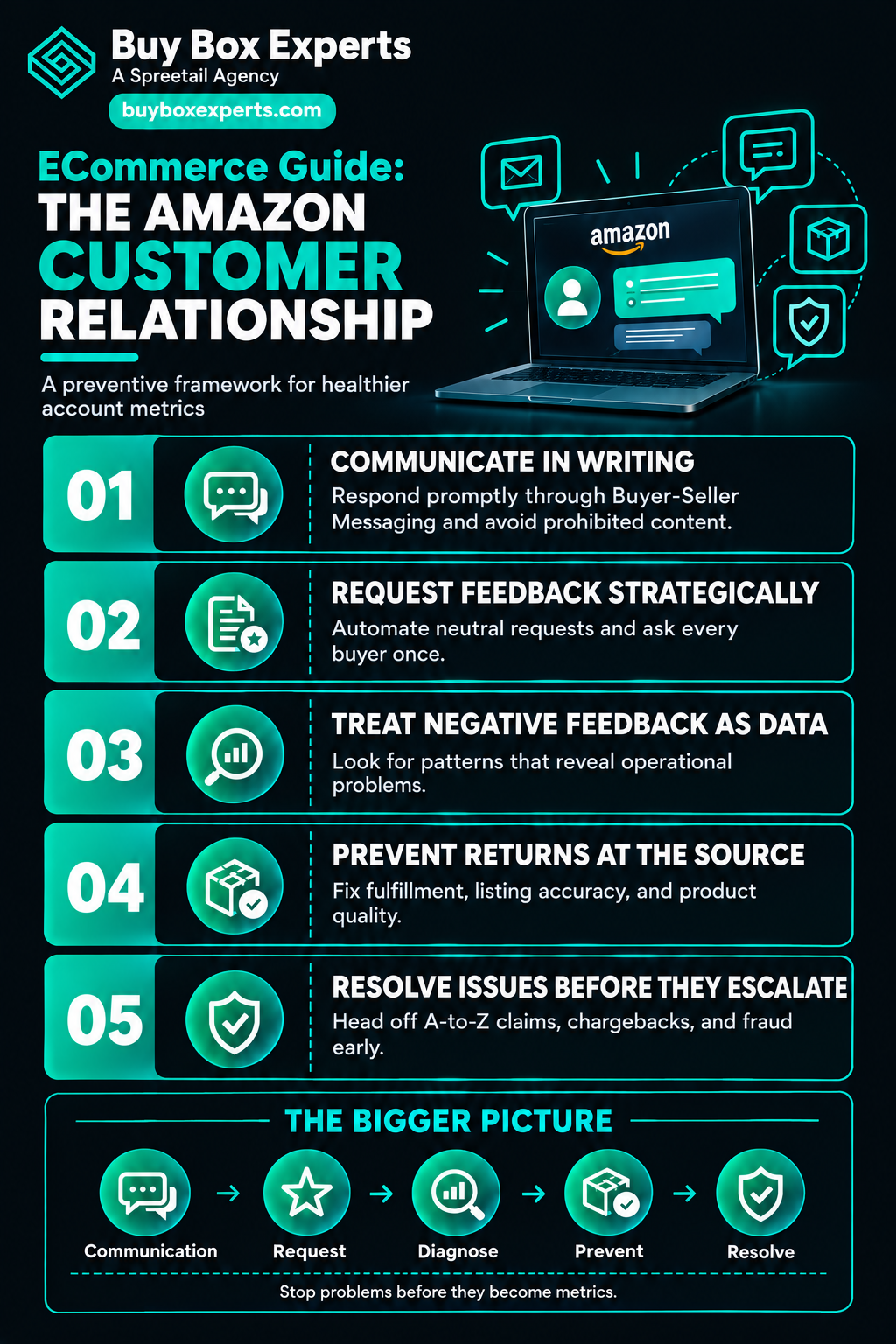
Your customer metrics (feedback ratings, return rates, claim rates, chargeback rates) aren’t personality traits of your business; they’re outputs of your operational systems. A seller with poor feedback typically doesn’t have bad customers; they have communication processes that miss disputes before they escalate. A seller with high returns doesn’t necessarily sell low-quality products; they might have fulfillment or listing accuracy problems.
This guide’s framework (documenting communication, analyzing feedback trends, preventing returns, responding to disputes) works because it’s preventive. It stops problems from becoming metrics-damaging events. It transforms customer friction into operational insights.
Sellers who excel here don’t spend more time on customer service; they spend strategic time on it: catching issues early, systematizing responses, analyzing patterns, and tightening operations.